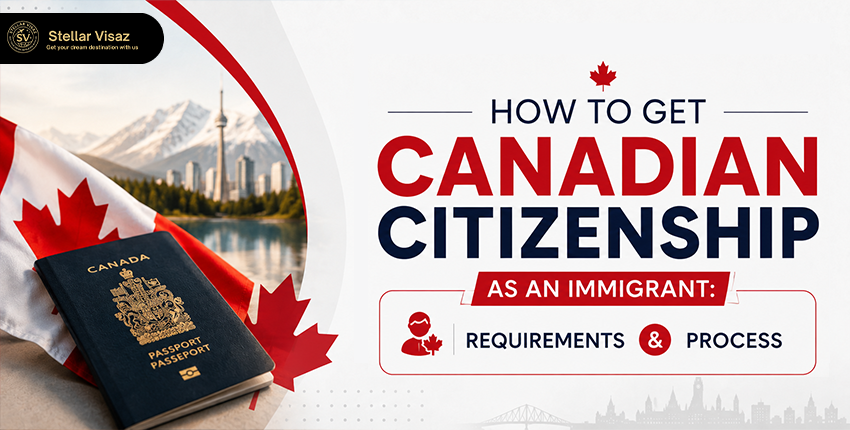
How to Get Canadian Citizenship as an Immigrant: Requirements & Process
Moving to Canada as an immigrant is a big achievement. For many newcomers, however, permanent residence is only one part of the journey. After living in Canada for several years, the next major goal is often becoming a Canadian citizen.
The good news is that the process is fairly straightforward if you understand the requirements and prepare your application carefully.
So, how do you get Canadian citizenship as an immigrant?
In most cases, you need to first become a permanent resident of Canada, live in Canada for the required amount of time, meet the tax and language requirements, pass the Canadian citizenship test if applicable, and then take the Oath of Citizenship.
This guide explains the process step by step.
Who Can Apply for Canadian Citizenship?
Most immigrants who become permanent residents can eventually apply for Canadian citizenship.
However, having permanent resident (PR) status does not automatically make you a Canadian citizen. You must meet the eligibility requirements set by Immigration, Refugees and Citizenship Canada (IRCC).
For an adult applicant, the main requirements include:
- You must have valid permanent resident status.
- You must have been physically present in Canada for at least 1,095 days (3 years) during the previous 5 years.
- You may need to have filed Canadian income taxes for at least 3 years within the relevant 5-year period.
- If you are between 18 and 54 years old, you generally need to prove your English or French language ability.
- If you are between 18 and 54, you generally need to pass the Canadian citizenship test.
- You must not be under a citizenship prohibition, such as certain criminal or security-related restrictions.
- If your application is approved, you must take the Oath of Citizenship.
It is important to remember that citizenship eligibility is based on your individual circumstances. Simply being a permanent resident for three years does not always mean you automatically qualify.
Step 1: Become a Permanent Resident of Canada
For most immigrants, the first step toward Canadian citizenship is becoming a permanent resident.
Canada has several immigration pathways, including economic immigration programs, family sponsorship and certain other immigration programs.
Once you become a permanent resident, you can begin building the physical presence required for citizenship.
Keep in mind that some time spent in Canada before becoming a permanent resident may also count toward citizenship eligibility.
Certain days spent in Canada as a temporary resident or protected person can count as a fraction of a day, subject to the applicable rules and maximum credit.
Because these calculations can become complicated, it is a good idea to use the official physical presence calculator before applying.
Step 2: Live in Canada for at Least 1,095 Days
One of the most important Canadian citizenship requirements is physical presence.
You generally need to have been physically present in Canada for at least 1,095 days within the 5 years immediately before you apply.
That is equivalent to three years.
However, you don't necessarily need to spend five years in Canada without travelling abroad. You can leave Canada during the eligibility period, but those days outside Canada generally do not count toward your physical presence.
IRCC recommends applying with more than 1,095 days if possible. This gives you some protection against mistakes when calculating your travel history or absences.
Example
Imagine you became a permanent resident and have lived in Canada for several years.
During that time, you spent six months visiting family overseas and took several shorter trips.
You shouldn't simply count the number of years you've held PR status. Instead, you need to calculate the exact number of days you were physically present in Canada during the five-year eligibility period.
This is why keeping records of your trips is so important.
Step 3: Check Your Tax Filing History
Taxes are another important part of the citizenship application.
Depending on your circumstances, you may need to have filed income taxes in Canada for at least 3 years during the 5-year period before applying.
This requirement applies when you were required to file taxes under Canadian tax law.
If you've lived and worked in Canada for several years, it's worth checking your tax history before submitting your citizenship application.
If you aren't sure whether you were required to file a tax return for a particular year, check your records with the Canada Revenue Agency or speak with a qualified tax professional.
Step 4: Meet the Language Requirement
If you are 18 to 54 years old on the day you sign your citizenship application, you generally need to demonstrate adequate knowledge of English or French.
You don't necessarily need to speak perfect English or French.
The requirement is focused on being able to communicate in one of Canada's official languages at the required level.
IRCC accepts certain language test results, certificates, diplomas and other documents as proof of language ability.
If you studied in English or French, for example, your education documents may potentially help demonstrate your language ability, depending on whether they meet IRCC's requirements.
Always check the current list of accepted documents before submitting your application.
Step 5: Take the Canadian Citizenship Test
Applicants between 18 and 54 years old generally have to take the Canadian citizenship test.
The test covers subjects such as:
- Canada's history
- Canadian geography
- Government
- Laws
- Rights and responsibilities of citizens
- Canada's economy
- Canadian symbols
The test is based on the official citizenship study guide, Discover Canada.
Don't leave studying until the last minute. Even people who have lived in Canada for many years can find some of the questions surprisingly specific.
A few weeks of regular preparation can make the process much less stressful.
Step 6: Submit Your Canadian Citizenship Application
Once you believe you meet all the requirements, you can prepare your citizenship application.
IRCC recommends applying online for most applicants because online applications are generally faster and more efficient than paper applications. Some applicants, however, must still apply on paper depending on their circumstances.
Before submitting your application, make sure:
- Your physical presence calculation is accurate.
- Your travel history is complete.
- Your tax information is correct.
- Your language documents meet the requirements, if applicable.
- Your identification documents are valid and complete.
- Your photographs meet the required specifications.
- You have paid the correct application fee.
- All information is consistent across your documents.
A small mistake doesn't necessarily mean your application will be refused, but incomplete or incorrect information can cause delays or lead IRCC to request additional information.
How Much Does Canadian Citizenship Cost?
As of 2026, the citizenship application fee for an adult is CAD $653, including the processing fee and the right of citizenship fee.
For a minor under 18, the fee is CAD $100.
Fees can change, so it's always smart to check the official IRCC fee page before paying.
The adult right of citizenship fee increased from $119.75 to $123 on March 31, 2026, while the adult processing fee remained $530.
What Happens After You Apply?
Submitting your citizenship application is not the final step.
After IRCC receives your application, it will review your documents and determine whether additional information or steps are required.
Depending on your situation, you may be asked to:
- Provide additional documents.
- Complete the citizenship test.
- Attend an interview.
- Provide fingerprints or other information if requested.
- Attend a citizenship ceremony.
Processing times can change depending on application volumes, staffing and the complexity of individual applications. IRCC's processing-time tool is the best place to check the current estimate.
Step 7: Take the Oath of Citizenship
If your application is approved, the final major step is the Oath of Citizenship.
The citizenship ceremony is an important moment because this is when you officially become a Canadian citizen.
Adults and minors aged 14 and older generally have to take the oath when required by the citizenship process.
After completing the ceremony, you'll receive proof of Canadian citizenship.
And yes — you can finally call yourself a Canadian citizen.
How Long Does It Take to Become a Canadian Citizen?
There isn't one fixed timeline for every immigrant.
The first part of the journey depends on how long it takes you to qualify for citizenship. Generally, you need at least 1,095 days of physical presence in Canada during the five-year eligibility period.
After you apply, the processing time depends on IRCC's workload and the details of your application.
It's therefore better not to plan around a specific number of months unless you have checked the current official processing-time estimate.
Can You Travel Outside Canada Before Applying for Citizenship?
Yes.
Permanent residents can travel outside Canada, but time spent outside the country can affect your citizenship physical presence calculation.
This is one of the most common areas where applicants make mistakes.
Before applying, make a list of every trip outside Canada during your eligibility period and compare it with your passport stamps, travel records and other documents.
If you're close to the 1,095-day requirement, consider waiting until you have a comfortable buffer rather than applying immediately at the minimum.
What Can Delay a Canadian Citizenship Application?
Several things can make the citizenship process take longer.
Common examples include:
- Missing documents
- Incorrect travel dates
- Incomplete application forms
- Problems with the physical presence calculation
- Missing or incorrect tax information
- Issues proving language ability
- Not being prepared for the citizenship test
- Criminal or security-related issues
- An application requiring additional review
The best approach is to slow down before submitting your application.
Taking an extra day to check everything is much better than discovering a mistake after your application has already been submitted.
Common Mistakes Immigrants Should Avoid
1. Applying as Soon as You Reach 1,095 Days
Technically meeting the minimum doesn't mean you have to apply that exact day.
If your calculation is off by a few days, you could create an unnecessary problem. IRCC itself recommends applying with more than 1,095 days when possible.
2. Guessing Your Travel History
Don't rely on memory alone.
Look through your passport, flight records, emails and other travel documents to make sure your dates are accurate.
3. Forgetting About Taxes
Review your Canadian tax filing history before applying.
4. Ignoring the Citizenship Test
Even if you've lived in Canada for years, it's worth studying the official material.
5. Using Outdated Information
Citizenship fees, forms and procedures can change.
Always check the latest information from IRCC before submitting an application.
Canadian Citizenship Checklist for Immigrants
- ☐ You have permanent resident status
- ☐ You meet the physical presence requirement
- ☐ You have checked your travel history
- ☐ You have met the applicable tax-filing requirements
- ☐ You meet the language requirement, if applicable
- ☐ You are prepared for the citizenship test, if applicable
- ☐ You have gathered the required documents
- ☐ You have checked that you're not subject to a citizenship prohibition
- ☐ You have paid the correct application fee
- ☐ You have reviewed the entire application before submitting it
Frequently Asked Questions About Canadian Citizenship
Possibly. You generally need at least 1,095 days of physical presence in Canada during the five years before applying, along with the other eligibility requirements. Simply having PR status for three years is not enough by itself.
No. You generally need 1,095 days of physical presence during the five-year eligibility period. That means you don't have to physically live in Canada for all five years.
If you are between 18 and 54 years old when you sign your application, you generally need to take the citizenship test.
Applicants aged 18 to 54 generally need to provide proof of adequate knowledge of English or French, unless an applicable exemption or waiver applies.
Canada allows dual citizenship, but whether you can keep your original
citizenship depends on the laws of your country of origin.
Before applying for Canadian citizenship, check the citizenship rules
of your home country as well.